
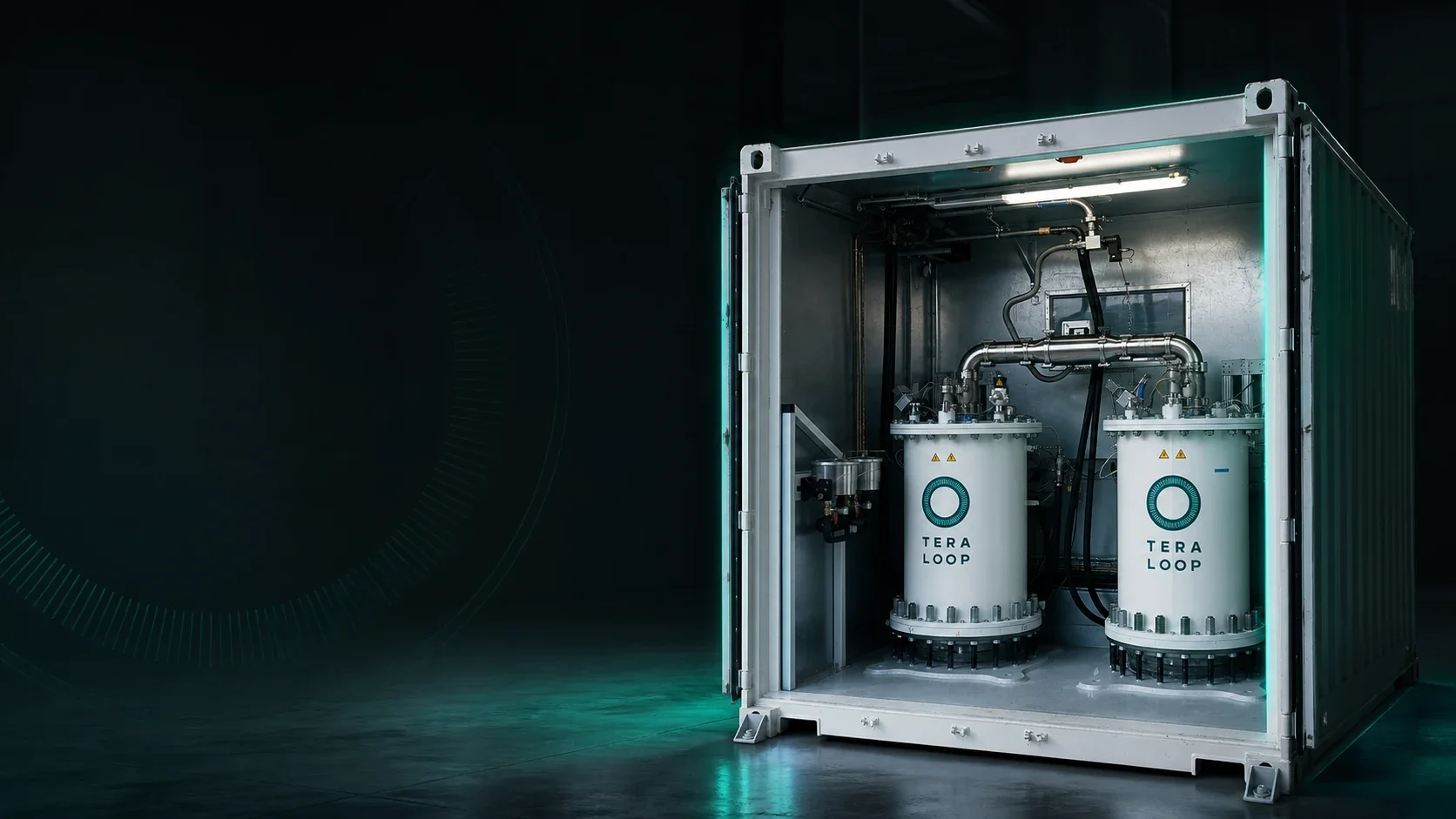
Flywheel energy storage, reimagined from the rotor out
A hubless carbon-fibre rotor, magnetically levitated, spinning in a vacuum. Engineered for fast, frequent power without the chemistry, the fuel, or the maintenance other storage needs.
WHERE IT FITS
Between a battery and a supercapacitor, without the compromises
Every storage technology trades power against duration. Supercapacitors give huge power for seconds. Batteries give hours of energy but degrade with every cycle and respond slowly. Teraloop sits in the gap the modern grid actually needs: high power delivered in milliseconds, useful energy on the scale of seconds to minutes, and no degradation no matter how often you cycle it.
THE CORE INNOVATION
We rebuilt the part every other flywheel gets wrong: the rotor
A flywheel stores energy in a spinning mass. The physics is simple, Ek = ½ I ω², so the stored energy rises with the square of rotational speed. Doubling the mass doubles the energy, but doubling the speed quadruples it. Speed is where the energy is.
The limit that stops a conventional flywheel from spinning faster is radial stress (σr), and that stress comes from the central hub. Teraloop removes the hub. In a hubless rotor the ratio of outer to inner diameter approaches one, and as it does the radial stress falls toward zero. With the radial stress gone, almost all the carbon fibre can be wound circumferentially, where it is strongest, so the material works at its full tensile limit.
Two things follow. The rotor reaches a very high specific energy, up to around 100 Wh/kg. And the diameter can scale, giving up to five times the storage capacity of a hubbed rotor and a larger torque arm, so the machine is far more power dense. Greater energy density and greater power density, from one change in geometry.
Hubbed rotor
Hubless rotor
fibre wound circumferentially
INSIDE THE FLYWHEEL
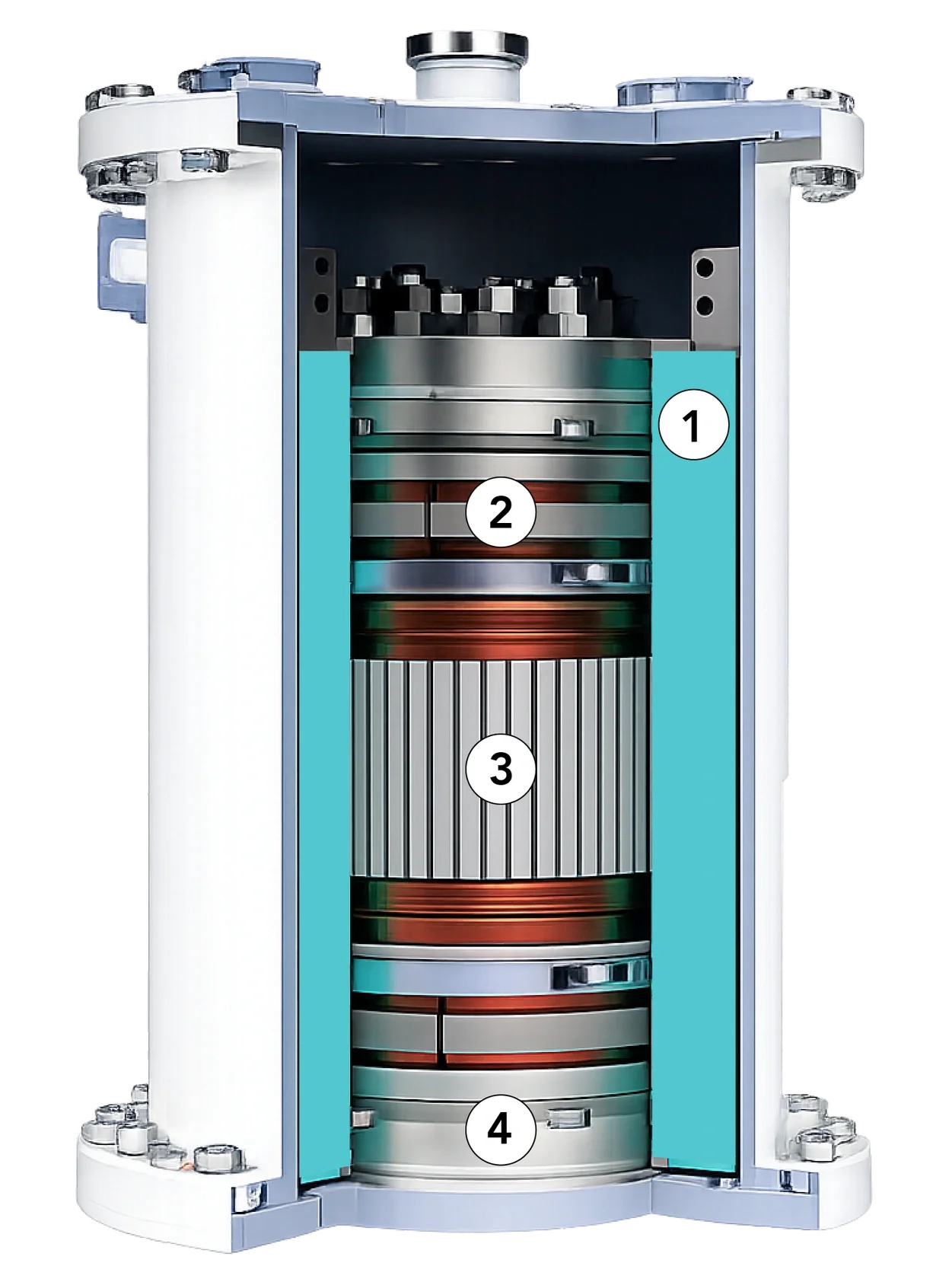
Three subsystems, one contact-free machine
-
The rotor is the unique element. It carries no central hub, so radial stress stays low and the carbon-fibre composite can be wound almost entirely in the strong circumferential direction. That gives up to five times the capacity of a hubbed rotor of the same class and lets the diameter scale with the application. Made of light, strong, recyclable carbon-fibre composite.
-
The Teraloop contact-free levitation system consists of a passive axial thrust bearing and radial active magnetic bearings with a permanent magnet bias field to provide superior efficiency. The system is managed by a real-time controller, which redundant and UPS backed up by the flywheel's own kinetic energy. Notably, the entire levitation system consumes less power than a typical light bulb.
-
A permanent-magnet synchronous machine acts as both motor and generator, charging the rotor up to speed and drawing the energy back out. It is built for high power density and high round-trip efficiency with minimal ancillary equipment. Teraloop targets recycled permanent magnets to remove any dependence on rare-earth elements.
-
Backup-bearings are used to catch the rotor in case of a rare malfunction of active magnetic bearings. Bearings are designed to bring the rotor to zero speed without damage on the rotor or rest of the system
-
Power electronics are used to convert the grid frequency 50/60Hz to high fundamental output frequency rotating rotor up to high speed (limited by rotor material). The power electronics feature state of the art control algorithms allowing seamless transition between grid forming and following.
Performance a chemistry cannot reach
-
Milliseconds, not seconds
Power in and out fast enough for grid forming or grid following
-
Unlimited cycling
Charge and discharge as often as the application needs, with no capacity fade
-
High power, small footprint
Up to one megawatt per square metre of floor area
-
No chemistry
No thermal runaway path, and the vacuum housing doubles as a safety container.
BY DESIGN
Safe by design
There is no flammable electrolyte and no chemistry to run away, so a Teraloop system cannot catch fire the way a battery can. The vacuum enclosure acts as a containment vessel, condition monitoring runs continuously, and an automatic shutdown procedure protects the system in the rare event of a fault. The result is a storage asset that is safe to site close to people and equipment, indoors or out, across a wide temperature range.
COMMON QUESTIONS
Flywheel technology, common questions
-
A flywheel stores electricity as kinetic energy in a spinning rotor. A motor speeds the rotor up to store energy, and the same machine runs as a generator to draw the energy back out, slowing the rotor down. Because kinetic energy rises with the square of rotational speed, higher speed stores far more energy than added mass.
-
Teraloop uses a hubless rotor. Removing the central hub drives radial stress toward zero, which lets almost all of the carbon fibre be wound in the strong circumferential direction. That gives a very high specific energy, up to around 100 Wh/kg, and lets the rotor diameter scale, so the system reaches up to five times the capacity of a hubbed rotor and a much higher power density.
-
It is a flywheel rotor with no central shaft or hub. In a hubless design the ratio of outer to inner diameter approaches one, and as it does the radial stress that normally limits flywheel speed falls toward zero, so the rotor can spin faster and store more energy for the same material.
-
The rotor is held by a combination of passive and active magnetic bearings, so it never physically touches anything, and it runs inside a deep vacuum. With no bearing friction and no air drag, the system has very low self-discharge and almost no wear, which is why it needs little maintenance.
-
No. Unlike a battery, the flywheel has no chemistry to age, so it can be charged and discharged an unlimited number of times with no capacity fade over the life of the system.
-
The rotor is built from abundant materials, mainly carbon and iron. Teraloop targets recycled permanent magnets for the motor to remove dependence on rare-earth elements, and the design uses no lithium or cobalt.
-
A supercapacitor delivers very high power but only for seconds. A battery delivers hours of energy but degrades with cycling and responds slowly. A Teraloop flywheel sits between them: high power in milliseconds, useful energy on the scale of seconds to minutes, and no degradation with cycling.
-
The Teraloop flywheel requires a vacuum, cooling, and a main power connection, all of which are integrated into a self-contained Flywheel Energy Storage System (FESS).
-
Effective storage time is 12-24hrs. Teraloop flywheels use permanent magnet motor/generator which results self-discharge of ~5-10%/hrs while it provides superior efficiency and dynamics under loading.
-
Yes, The design of Teraloop flywheels allows them to tolerate and dampen significant external forces, including seismic activity (earthquakes).
Want to go deeper with our engineers?
We are running a technical webinar series on how the system works and how it integrates. Get in touch and we will bring you into the next one.